Pillar 02 · Experimentation

Anyone on your team can run
real research.

Wizards walk your bench scientists through experimental design in plain English — A/B tests, factor screens, optimization runs, mixture experiments. Power analysis is baked in. Media sheets and randomization labels print themselves. The research that comes out holds up to the same statistical rigor as a clinical trial.

fig. 02
[ figure · response surface from a 3-factor mixture experiment ]
How we think about it

Exploring and proving are not the same thing.

There's a large difference between research that moves your operation and people exploring on the bench. Without statistical power, the team running an experiment can't tell whether the effect they saw was real or just sample-to-sample noise — and the result, real or not, ends up in a notebook on someone's desk. Our wizards remove that uncertainty by baking the math behind the screens. Bench scientists pick the hypothesis they want to test; the wizards work backward to the sample size required, the randomization needed, and the media sheets to print. What comes out is research that any statistician would sign off on.

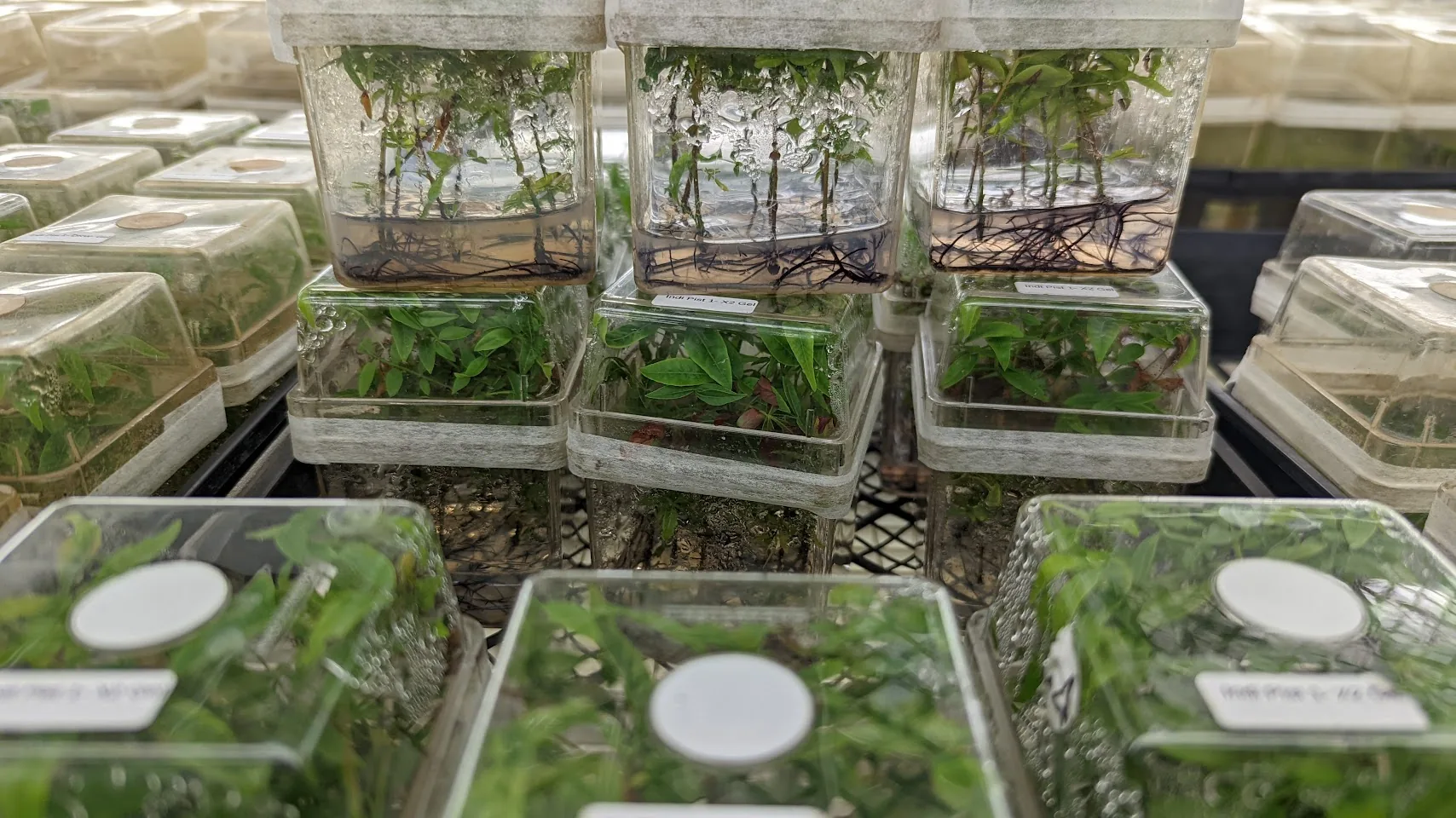
Stacks of tissue culture boxes on the bench — mature rooted cultures up top, earlier-stage material below — a trial in progress
[ photo · research on the shelf · courtesy of TissueGrown Corp. ]
How it works

Six principles, in plain English.

01 A wizard for every type of experiment. A/B tests for two-treatment comparisons. Factor screens for which variables matter and which don't. Optimization runs (response-surface designs) for finding the best operating point. Mixture experiments for media formulation. Every wizard walks your team through the design in plain English — pick what you're measuring, pick what you're varying, the system handles the math.
02 Power analysis, baked into every wizard. Before any experiment runs, the wizard calculates how many replicates and treatments you need to detect the effect that matters to your operation. The recommendation comes from your own baseline — historical performance from your data — not a textbook constant. If the design can't detect the gap you care about, you find out before you start.
03 Research framed in your production system. Every experiment is anchored to the production network it affects. The wizard knows what a multiplication rate is in your operation, what stage you're running on, what your media costs are, what your weekly throughput target is. The cost-benefit calculation is done in your economics — what this experiment costs versus what hitting your production goal is worth.
04 All research in one place. Visibility you control. Every trial, every result, every replicate lives in a central library — searchable, filterable, attached to the recipe that won. Visibility is yours to set: only the admin sees everything, only the research team, or everyone. Your team's research stays available to the operation that paid for it, not trapped in a notebook on someone's desk.
05 Media sheets and labels, printed for you. Salt optimization for your media? Once the design is chosen, the system generates per-treatment media sheets adapted from your base recipe — every concentration calculated, every container assigned, every prep step spelled out. The label-printing wizard follows: every replicate gets a randomized label so the bench team can collect data without remembering the design.
06 Photos for measurement. Forever. Manual measurement of plant size takes hours; photos of the same boxes take seconds. Computer vision pulls measurements out of the images — and the photos stay attached to the experiment forever, so anyone can come back later, re-measure, and answer a question that wasn't asked the first time.
Plus the team

Experimentation experts who can do your research too.

Your subscription includes hours of experimentation experts — statisticians and bench scientists who walk your team through design, troubleshoot in-progress runs, and analyze the output. And because the platform encrypts your proprietary details before they reach us, we can run research for you in your domain — without ever seeing the specific values that make your operation work. The allocated hours are yours to spend however you see fit: training, hands-on design, or full-service research on a question you don't have time to chase.

The one-line version

Don't waste time on research
that can't prove a hypothesis.

Talk to us about the experiment you've been putting off.

Talk to us

How we engage

We start with a 30‑minute conversation about your operation. If we're a fit, we visit; if we're not, we'll point you to someone who is.